


DIN 913 is a hexagon socket set screw (grub screw) with a flat point, defined by the German standards body DIN. It has been withdrawn and replaced by ISO 4026 — an international standard with identical dimensions, so the two are fully interchangeable in practice. DIN 916 is a different set screw from the same family: same hex-socket drive, but with a cup point that bites into the mating shaft for stronger holding force. The choice between them comes down to one question: do you need to remove the assembly later, or is it permanent?
What Is DIN 913? The Flat-Point Grub Screw Explained
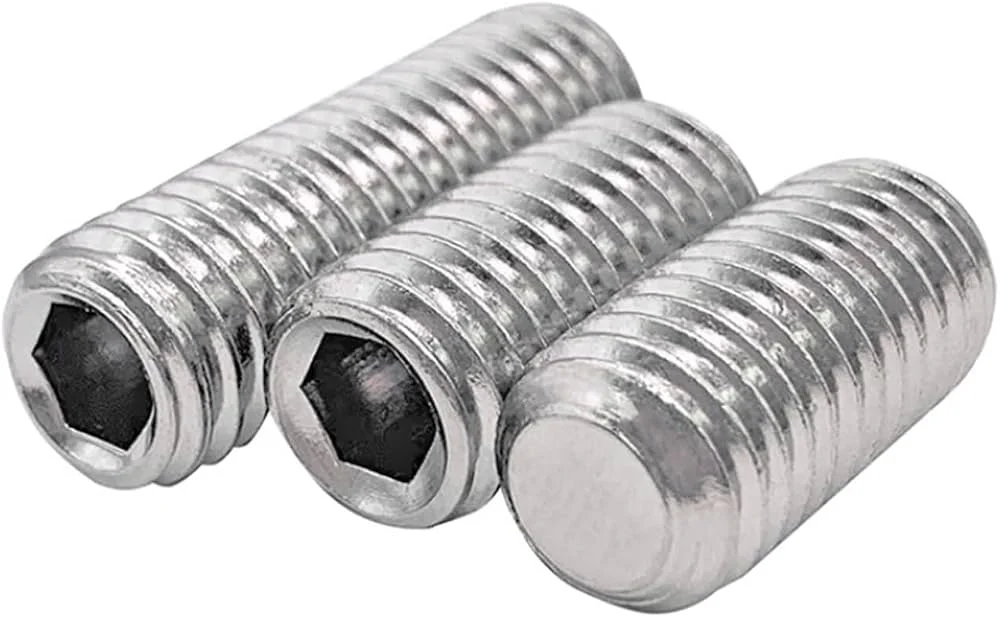
DIN 913 is a hexagon socket set screw with a flat point. It is a fully-threaded, headless fastener — no protruding head above the surface — driven by an Allen (hex) key through an internal socket. The working end is a smooth, flat face that presses directly against the mating surface without penetrating it.
The “DIN” prefix means the standard was published by Deutsches Institut für Normung (German Institute for Standardization). DIN 913 was one of a family of four set screw standards — all sharing the same hex-socket drive but differing only in point geometry:
| Standard | Point Type | ISO Equivalent |
|---|---|---|
| DIN 913 | Flat point | ISO 4026 |
| DIN 914 | Cone point | ISO 4027 |
| DIN 915 | Dog (cylindrical) point | ISO 4028 |
| DIN 916 | Cup point | ISO 4029 |
A DIN 913 set screw is also widely called a grub screw in British English, or a set screw in North American English. They are the same thing.
Key Specifications
| Parameter | DIN 913 |
|---|---|
| Drive | Hexagon socket (Allen key) |
| Point type | Flat |
| Thread | Metric coarse |
| Size range | M1.6 – M24 |
| Length range | 2 – 300 mm |
| Property class (steel) | 14H, 45H |
| Material (stainless) | A2, A4 (per ISO 3506-3) |
| Surface finish | Plain (self-colour), blackened |
| Standard status | Withdrawn — replaced by ISO 4026 |
What “withdrawn” actually means in practice: The DIN 913 standard no longer receives updates, but the parts themselves are still manufactured and sold every day. Any supplier quoting you ISO 4026 in place of DIN 913 is quoting the correct current-standard equivalent — they are dimensionally identical.
How a Flat-Point Set Screw Works
The flat end bears against the mating shaft or surface through direct pressure. When tightened, it clamps by friction alone — no indentation, no bite geometry. This makes it the right choice when:
- The shaft or surface must remain undamaged for reuse
- The assembly will be adjusted or repositioned
- Light to moderate axial or rotational loads are present
- The mating material is softer (aluminium, brass, plastic)
The tradeoff is lower holding force compared to point types that mechanically engage the surface. Under vibration or high torque, a flat-point screw is more likely to back out than a cup-point (DIN 916).
DIN 913 vs ISO 4026: Are They Actually the Same?
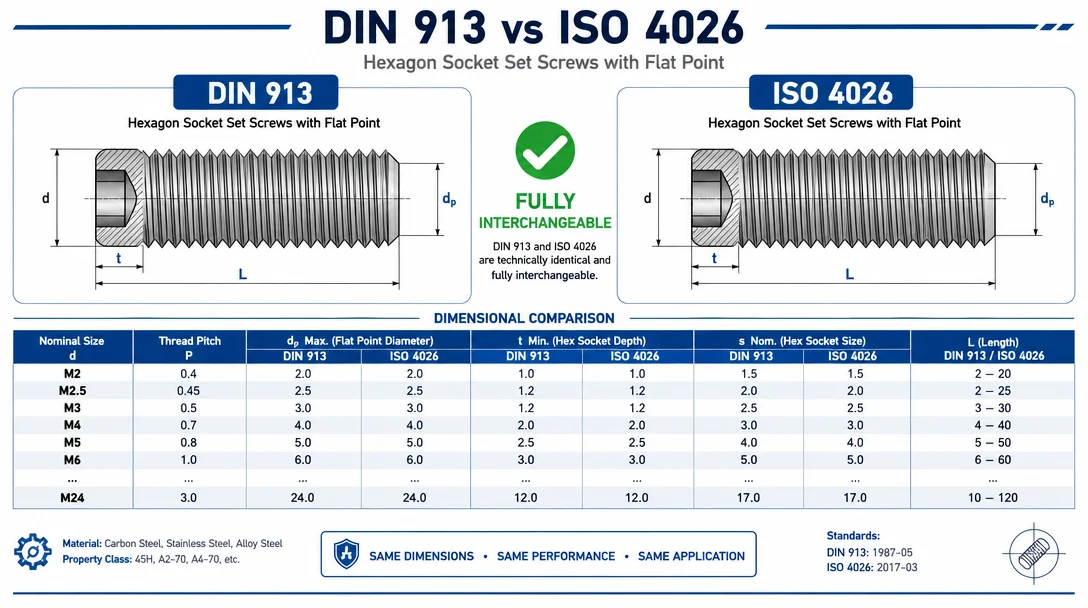
Yes — DIN 913 and ISO 4026 are dimensionally identical and fully interchangeable. This is the most common question engineers ask, and the answer is unambiguous.
When ISO moved to harmonize fastener standards internationally, DIN 913 was superseded by ISO 4026. The ISO standard adopted the same dimensions, the same thread tolerances, and the same drive geometry. Westfield Fasteners’ technical documentation states it plainly: “Although the DIN 913 standard has been superseded by ISO 4026, the dimensions are the same and off-the-shelf parts could be marked with either standard.”
The One Real Difference: Size Coverage
ISO 4026 does not cover every size that DIN 913 originally defined. The following sizes exist in DIN 913 but are absent from ISO 4026:
- M1.4
- M1.8
- M14
- M18
- M22
Additionally, DIN 913 included certain intermediate lengths that ISO 4026 omits. For the overwhelming majority of applications — M2 through M24 in standard lengths — there is zero practical difference.
If you need M14, M18, or M22: You are sourcing to a DIN 913 specification that ISO 4026 does not cover. Specify DIN 913 explicitly on your drawing and confirm with your supplier.
What to Write on a Modern Engineering Drawing
If your drawing currently calls out DIN 913, you have three options:
- Leave it as DIN 913 — suppliers understand it; the parts are interchangeable with ISO 4026
- Update to ISO 4026 — preferred for new designs; aligns with current international standard
- Call out both — e.g., “ISO 4026 (formerly DIN 913)” — useful during a drawing update transition period
For sizes M14, M18, or M22, you must retain the DIN 913 callout or specify to a custom standard, since ISO 4026 does not define those sizes.
DIN 913 vs ISO 4026: Side-by-Side
| Attribute | DIN 913 | ISO 4026 |
|---|---|---|
| Standard body | DIN (Germany) | ISO (International) |
| Standard status | Withdrawn | Active |
| Dimensions | Identical | Identical |
| Thread tolerance | 6g | 6g |
| Product grade | A | A |
| Size range | M1.4 – M24 | M1.6 – M24 (excl. M14, M18, M22) |
| Interchangeable? | Yes | Yes |
| Preferred for new designs? | No (withdrawn) | Yes |
DIN 913 vs DIN 916: Flat Point vs Cup Point
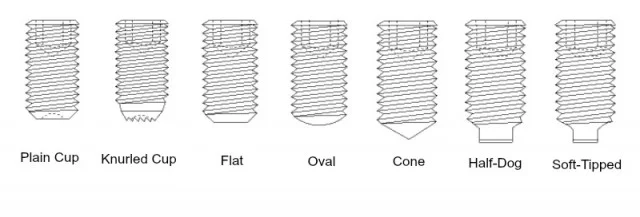
DIN 913 (flat point) and DIN 916 (cup point) look nearly identical from the outside but behave very differently at the working end. Both are hex-socket set screws in the same size range with the same material options. The difference is entirely in the point geometry — and that geometry determines whether the assembly is repositionable or effectively permanent.
Understanding the Cup Point (DIN 916)
The DIN 916 cup point has a small concave rim at the tip — like an upturned crown. When tightened against a shaft, that rim digs into the surface, creating a shallow circular groove. Woodstock Industrial describes it accurately: “The hollow cup point bites into the shaft for a firm friction grip without a locating dimple — the general-purpose socket set screw for collars, couplings and pulleys.”
This bite creates two holding mechanisms working together:
- Friction from clamping force (same as flat point)
- Mechanical interlock from the indentation in the shaft
The result is significantly higher resistance to both axial sliding and rotational slip under dynamic loads.
Head-to-Head Comparison
| Attribute | DIN 913 — Flat Point | DIN 916 — Cup Point |
|---|---|---|
| Point geometry | Smooth, flat face | Concave cup/rim |
| ISO equivalent | ISO 4026 | ISO 4029 |
| Holding force (torsional) | Lower | Higher |
| Shaft damage | Minimal surface marking | Permanent ring indentation |
| Reversibility | Fully reversible | Semi-permanent |
| Re-positioning | Yes — no shaft damage | Leaves mark; re-positioning degrades grip |
| Best for vibration | Poor — can back out | Good — cup locks position |
| Soft shafts (Al, brass) | Recommended | Use with caution (deep mark) |
| Hard shafts (tool steel) | Use if position adjustable | Preferred for permanent lock |
| Typical applications | Precision adjustments, light duty, prototype | Shaft collars, pulleys, couplings, final assembly |
| Risk of wrong choice | Assembly slips under load | Shaft surface damaged if removed |
Which One to Choose: A Decision Framework
Use DIN 913 (flat point) when:
- The assembly will be adjusted, repositioned, or disassembled during its service life
- The shaft surface must remain undamaged (precision-ground shaft, expensive component)
- The mating material is soft (aluminium, brass, plastic) and a cup rim would cause excessive damage
- Loads are light and primarily axial, not rotational
- You are prototyping and final position is not yet determined
Use DIN 916 (cup point) when:
- The assembly is intended to be permanent or semi-permanent
- You need resistance to vibration and rotational slip
- The shaft can tolerate a surface mark (mild steel, unhardened shaft)
- The application involves shaft collars, pulleys, sprockets, or couplings
- You need the most grip from the smallest envelope (no space for a key or pin)
A real-world example from industrial practice: In a conveyor system, the drive pulley hub is specified with DIN 916 cup-point screws because the hub will never need repositioning and vibration from the belt could work a flat-point screw loose over time. The idler pulleys — adjusted seasonally for belt tension — use DIN 913 flat-point screws so the shaft remains undamaged during periodic adjustment.
Materials and Property Classes: What to Specify
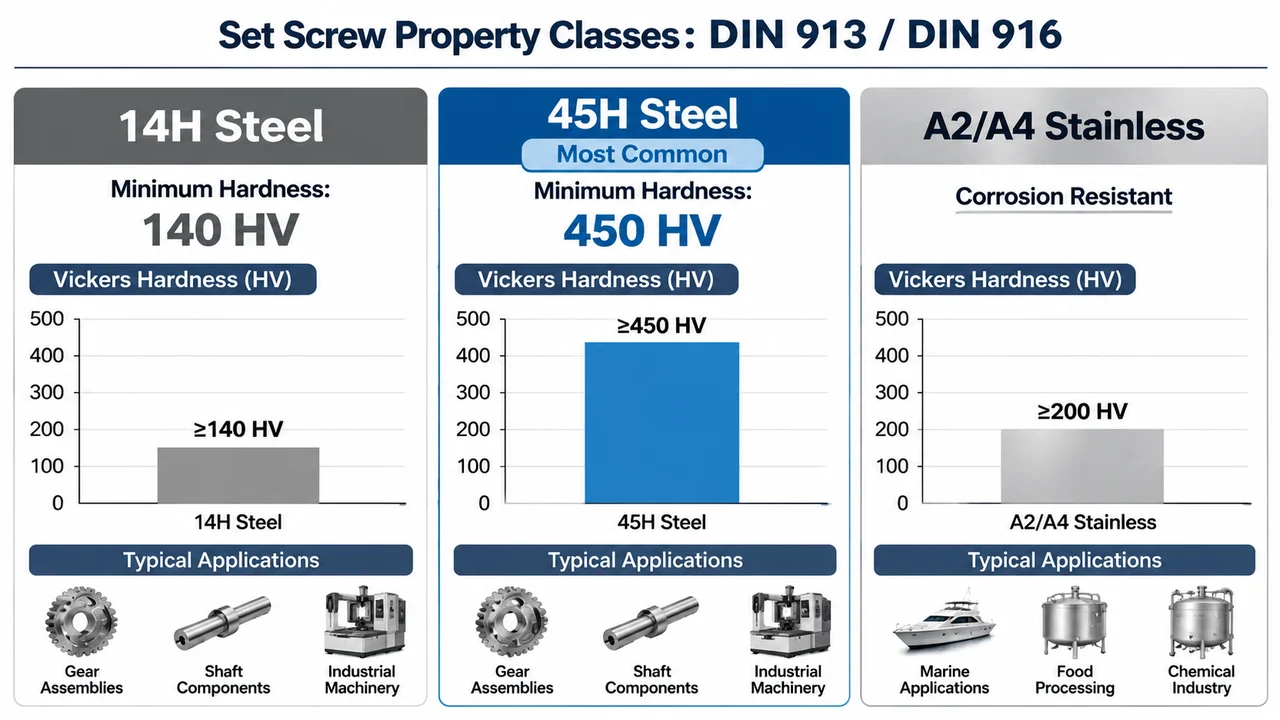
Both DIN 913 and DIN 916 are available in the same material grades. Getting this wrong is a common source of fastener failures that have nothing to do with point geometry.
Steel Property Classes
| Class | Hardness | Equivalent Grade | Typical Use |
|---|---|---|---|
| 14H | Min. 140 HV | ~Grade 8 (approximate) | Light-duty, general purpose |
| 45H | Min. 450 HV | Grade 14.9 (highest) | High-strength, standard choice for most industrial |
Property class 45H is the standard commercial grade for hex socket set screws. The “45H” designation comes from ISO 898-5. The minimum hardness of 450 HV means these screws are harder than the shaft they’re clamping against in most applications — which is why they can mark a shaft without being damaged themselves.
Stainless Steel Grades
| Grade | Standard | Corrosion Resistance | Typical Use |
|---|---|---|---|
| A2 | ISO 3506-3 | Good — suitable for general corrosive environments | Food processing, marine (mild), chemical |
| A4 | ISO 3506-3 | Excellent — suitable for chloride environments | Marine (severe), pharmaceutical, offshore |
Note: Stainless steel set screws have lower hardness than steel 45H. In applications requiring high clamping force, steel is preferred. Where corrosion is the primary concern and loads are moderate, A2 or A4 stainless is the right call.
Common Mistakes When Specifying Set Screws
After reviewing hundreds of drawing packages from B2B customers, these are the errors that show up most often:
1. Calling out DIN 913 when ISO 4026 is preferred
Not a critical error, but it shows a drawing hasn’t been updated since the 1990s. Suppliers know what you mean; ISO 4026 is the current standard.
2. Using flat-point (DIN 913) in a high-vibration application
The flat point relies entirely on friction. Under continuous vibration, it will back out. DIN 916 or a thread-locking compound with DIN 913 is the correct solution.
3. Using cup-point (DIN 916) on a precision-ground shaft that will be reused
The cup rim leaves a permanent ring mark. If that shaft feeds into a bearing or seal, that mark creates a leak path or bearing pre-load issue. Use DIN 913 and accept lower holding force, or add a soft pad (brass, nylon) under the screw.
4. Specifying stainless (A2/A4) in a high-torque application
Stainless set screws are softer than steel 45H. Under high tightening torque, the hex socket can strip, or the screw can deform. Confirm the torque spec against the material grade.
5. Mixing DIN 913 and ISO 4026 on the same assembly drawing
They are interchangeable, but inconsistent callouts create confusion in procurement and inspection. Pick one standard and use it throughout.
FAQ
What is DIN 913?
DIN 913 is a German standard (now withdrawn) for a hexagon socket set screw with a flat point. It is a headless, fully-threaded fastener driven by an Allen key, with a smooth flat working end that presses against a mating surface without penetrating it. The current equivalent standard is ISO 4026.
Is DIN 913 the same as ISO 4026?
Yes, for all practical purposes. The dimensions, thread tolerances, and drive geometry are identical. The only difference is that ISO 4026 omits sizes M1.4, M1.8, M14, M18, and M22, which DIN 913 originally covered. Parts marked either standard are fully interchangeable.
Why was DIN 913 withdrawn?
DIN 913 was harmonized into the international ISO 4026 standard as part of a broader effort to align German national standards with ISO equivalents. The withdrawal does not mean the product is discontinued — parts are still manufactured and widely available; they are simply now catalogued under ISO 4026.
What is the difference between DIN 913 and DIN 916?
Both are hex-socket set screws in the same size range, but DIN 913 has a flat point (smooth end, no indentation) while DIN 916 has a cup point (concave rim that bites into the shaft). DIN 916 provides higher holding force but leaves a permanent mark on the shaft. DIN 913 is reversible and leaves minimal surface damage.
When should I use a cup point (DIN 916) instead of a flat point (DIN 913)?
Use DIN 916 when the assembly is permanent or semi-permanent, subject to vibration, or needs to resist rotational slip. Use DIN 913 when the assembly will be adjusted or removed, or when shaft surface integrity must be maintained.
Can DIN 913 and DIN 916 be tightened with the same Allen key?
Yes. Both standards use the same hexagon socket dimensions for a given thread size. An M6 DIN 913 and an M6 DIN 916 both require the same 3 mm Allen key.
What property class is DIN 913?
DIN 913 is typically supplied in property class 45H (steel, minimum 450 HV hardness, equivalent to ISO 898-5) or in stainless steel grades A2 or A4 (per ISO 3506-3).
Summary
DIN 913 is a flat-point hex-socket set screw — still widely specified, still widely available, but technically superseded by the dimensionally-identical ISO 4026. If you are updating a drawing or starting a new design, use ISO 4026. If you are sourcing against an existing DIN 913 callout, any ISO 4026 part will fit.
The comparison with DIN 916 is more consequential: flat point vs cup point is a functional choice, not just a naming convention. Flat point (DIN 913 / ISO 4026) is for adjustable, low-damage applications. Cup point (DIN 916 / ISO 4029) is for permanent, high-grip installations. Get that choice wrong and you will either damage a shaft you needed to reuse, or watch a collar slip under load.
Both are available in the same materials and sizes. The Allen key is the same. The only thing that changes is the point — and that point makes all the difference.