


Titanium fasteners are bolts, screws, nuts, and washers manufactured from titanium or titanium alloys, primarily Grade 2 (commercially pure) and Grade 5 (Ti-6Al-4V). They offer a density of 4.43–4.51 g/cm³ depending on grade — roughly 43–44% lighter than steel — combined with high tensile strength, exceptional corrosion resistance in seawater and chloride environments, and biocompatibility. Grade 5 delivers up to 1,020 MPa tensile strength at half the weight of equivalent stainless steel hardware. These properties make titanium fasteners the material of choice in aerospace, marine, medical, automotive, and chemical processing applications where every gram and every corrosion point counts. This guide covers all major grades, fastener types, mechanical properties, key applications, the critical galling risk, and how to correctly specify titanium fasteners to industry standards.
What Are Titanium Fasteners?

Various titanium fasteners: hex bolts, socket head cap screws, nuts, and washers. Left: Grade 2 (CP) for corrosion-critical use; right: Grade 5 (Ti-6Al-4V) for structural/aerospace use.
Titanium fasteners are mechanical joining components — bolts, screws, nuts, washers, studs, and rivets — made from titanium or titanium-based alloys. Unlike commodity hardware, they are engineered for applications where the combination of low weight, high strength, and long-term corrosion resistance justifies a significant cost premium over standard steel or stainless steel.
The material itself sits in an unusual position on the periodic table. Titanium (Ti, atomic number 22) has a density of 4.51 g/cm³, making it 43% lighter than carbon steel (7.85 g/cm³) and 69% lighter than nickel superalloys — yet alloyed with aluminum and vanadium (Grade 5, Ti-6Al-4V), it reaches tensile strengths exceeding 1,000 MPa. That combination is why aerospace engineers have specified titanium fasteners since the 1950s.
What distinguishes titanium fasteners from generic “exotic” hardware is the specificity of grade and standard. A titanium bolt isn’t just titanium — it’s Grade 2 or Grade 5 or Grade 23, manufactured to ASTM F468 or AMS 4928, with traceable material certifications. Getting the grade wrong can mean the difference between a part that lasts 20 years in seawater and one that fails under cyclic load in six months.
In our experience supplying titanium fasteners to aerospace OEMs and marine equipment manufacturers, the most common specification mistake is defaulting to Grade 5 for everything. Grade 5 is the right answer much of the time — but not always.
Titanium Fastener Grades: Which One Do You Need?
Titanium is classified into two broad families: commercially pure (CP) titanium (Grades 1–4, 7, 11, 12) and titanium alloys (Grades 5, 6, 9, 23, and others). For fasteners, six grades cover the vast majority of industrial applications.
Grade 2 — The Commercial Workhorse
Grade 2 (UNS R50400) is the most widely used commercially pure titanium for fasteners. It contains no meaningful alloying additions — over 99% titanium — which gives it the best corrosion resistance of any fastener-grade titanium. The tradeoff is lower strength: tensile strength runs approximately 345–480 MPa, comparable to mild steel but far below alloy grades.
Where Grade 2 excels is in highly corrosive chemical environments where strength isn’t the limiting factor — acid wash tanks, chloralkali plants, seawater piping flanges. Its purity makes it more resistant to pitting and crevice corrosion than Grade 5 in aggressive chloride environments, and significantly more resistant than 316 stainless steel.
Governing standard: ASTM F468 / F467 (Grade 2)
Grade 5 (Ti-6Al-4V) — The Aerospace Standard
Grade 5 is the most common titanium alloy in the world, accounting for roughly 50% of all titanium used. The alloy composition — 6% aluminum, 4% vanadium, balance titanium — gives it a tensile strength of approximately 1,020 MPa (148 ksi) with a yield strength of ~951 MPa (138 ksi) at a density of 4.43 g/cm³.
For comparison: 316 stainless steel has a tensile strength of approximately 515 MPa at a density of 8.0 g/cm³. That means Grade 5 titanium delivers roughly twice the strength at nearly half the weight.
Grade 5 fasteners are the standard choice for aerospace structural connections, high-performance automotive applications, and any situation where both strength and weight matter. The grade is also corrosion-resistant in most environments — though slightly less so than Grade 2 in concentrated acids.
Governing standard: ASTM F468 / AMS 4928
Grade 7 — The Chemical Processing Grade
Grade 7 (UNS R52400) adds 0.12–0.25% palladium to commercially pure titanium. This small palladium addition dramatically improves resistance to reducing acids — hydrochloric acid, sulfuric acid at elevated temperatures — where Grade 2 would corrode. If your application involves contact with reducing chemical media, Grade 7 is the right choice over Grade 2 or Grade 5.
The cost premium over Grade 2 is significant due to the palladium content, so Grade 7 fasteners are specified only when the chemical environment demands it.
Governing standard: ASTM F468 (Grade 7)
Grade 9 (Ti-3Al-2.5V) — The Tubing and Medium-Strength Grade
Grade 9 sits between Grade 2 and Grade 5 in both strength and cost. With a tensile strength around 620–690 MPa, it offers better formability than Grade 5 and is commonly used in hydraulic tubing, bicycle frames, and applications where intermediate strength with better ductility is preferred.
For fasteners, Grade 9 appears in specialized aerospace and cycling hardware. It’s less common than Grade 2 or Grade 5 for standard bolting.
Grade 23 (Ti-6Al-4V ELI) — Medical and Implant Grade
Grade 23 is essentially Grade 5 with extra-low interstitial (ELI) element content — reduced oxygen, nitrogen, and iron. The tighter chemistry reduces oxygen to a maximum of 0.13% (vs. 0.20% in Grade 5), which improves fracture toughness and fatigue resistance in biological environments.
Medical screws, bone anchors, and spinal fusion hardware are almost exclusively Grade 23. The ELI designation ensures biocompatibility at the level required by FDA and ISO 10993 standards. If you’re sourcing titanium fasteners for medical devices or implants, Grade 23 is not optional — Grade 5 is not an acceptable substitute.
Governing standard: ASTM F136 (medical implant applications)
Grade Comparison Table
| Property | Grade 2 (CP) | Grade 5 (Ti-6Al-4V) | Grade 7 | Grade 9 | Grade 23 (ELI) |
|---|---|---|---|---|---|
| Tensile Strength | 345–480 MPa | ~1,020 MPa | 345–480 MPa | 620–690 MPa | ~900 MPa |
| Yield Strength | 275–380 MPa | ~951 MPa | 275–380 MPa | 520–590 MPa | ~830 MPa |
| Density | 4.51 g/cm³ | 4.43 g/cm³ | 4.51 g/cm³ | 4.46 g/cm³ | 4.43 g/cm³ |
| Corrosion Resistance | Excellent | Very Good | Superior (reducing acids) | Good | Very Good |
| Biocompatibility | Good | Good | Good | Good | Excellent |
| Primary Applications | Chemical, marine, general | Aerospace, automotive, motorsport | Chemical processing | Cycling, aerospace tubing | Medical implants |
| Relative Cost | Medium | High | Very High | High | Very High |
Types of Titanium Fasteners
Titanium fasteners span the same range of types as steel hardware. The distinction is that each type demands attention to grade, finish, and head style because titanium behaves differently from steel during installation.
Titanium Bolts
Titanium bolts are available in hex head (the standard external drive), socket head cap (hex socket drive, common in aerospace for weight savings and clean profiling), button head socket cap, and countersunk/flat head configurations. Grade 5 socket head cap bolts in M4–M16 are the most commonly ordered form in our experience.
Thread forms are standard metric (DIN/ISO) or unified inch (UNC/UNF), manufactured to the same dimensional standards as steel hardware. The critical difference is torque specification — titanium bolts have a lower modulus of elasticity (~114 GPa vs. ~200 GPa for steel), which means they stretch more per unit of applied torque. Using steel torque tables for titanium bolts will result in undertorquing or overtorquing.
Titanium Screws
Titanium screws include machine screws (fully threaded, standardized head forms), self-tapping screws (for thin metal or plastic), and specialty forms like hex flange screws. In motorsport and cycling, titanium M5 and M6 screws in button head or cap head form are among the highest-volume titanium fastener products.
One point that every installer should know: titanium screws threaded into titanium tapped holes (or titanium nuts) are at extreme risk of galling — see the dedicated section below. Using titanium screws into aluminum or steel hosts is far less problematic.
Titanium Nuts
Titanium nuts — hex nuts, flange nuts, nyloc (prevailing torque) nuts, and jam nuts — are manufactured to ASTM F467. The challenge with titanium nuts is the same as titanium bolts: galling risk when mated with titanium fasteners. For structural titanium assemblies, it’s common to pair Grade 5 bolts with Grade 5 nuts but lubricate both with an appropriate thread compound.
Nyloc-style titanium nuts use a nylon insert and can only be used at temperatures below the nylon’s rated limit (typically 120°C). For high-temperature applications, all-metal prevailing torque nuts are required.
Titanium Washers
Titanium washers — flat (plain) washers, fender washers, and spring/lock washers — serve the same function as steel washers but add the corrosion resistance of titanium to the joint. They’re critical in dissimilar-metal joints: placing a titanium washer between a titanium bolt head and an aluminum or stainless steel surface prevents galvanic bite while distributing load.
Grade 2 washers are the most common choice for corrosion-critical marine joints. Grade 5 washers appear in aerospace applications where even washer weight is monitored.
McMaster-Carr notes that Grade 2 titanium (99% pure) is “even more corrosion resistant than other common titanium grades, such as Grades 5 and 9” — which is why Grade 2 dominates washer and nut applications in chemical environments.
Titanium Studs and Threaded Rods
Studs (fully threaded or partially threaded) and threaded rods in Grade 2 and Grade 5 are used in flanged connections, particularly in chemical processing and marine engineering. ASTM B348 covers titanium bar stock from which studs are machined.
Titanium Rivets
Solid titanium rivets are used in aerospace skin panels and other sheet-metal assemblies where blind fasteners aren’t suitable. Grade 5 is the standard choice for structural rivets; Grade 2 for applications prioritizing corrosion resistance over strength.
Mechanical and Physical Properties: The Numbers That Matter
The business case for titanium fasteners rests on specific measurable properties, not marketing language. Here are the numbers from verified sources.
Density: 4.43–4.51 g/cm³ depending on grade. Carbon steel: 7.85 g/cm³. 316 stainless steel: ~8.0 g/cm³. This means a titanium fastener of the same geometry is approximately 43% lighter than carbon steel and 44% lighter than 316 stainless.
Tensile Strength (Grade 5): ~1,020 MPa (148 ksi). 316 stainless: ~515 MPa. Grade 5 titanium delivers approximately twice the tensile strength of 316 stainless at nearly half the weight — the extreme-bolt.com datasheet accurately describes this as “4× stronger than 316 stainless at nearly half the weight” when expressing the specific strength (strength ÷ density) ratio.
Modulus of Elasticity: 114 GPa (Grade 5). Steel: ~200 GPa. Titanium fasteners are about 43% less stiff than steel. This matters for joint design — titanium joints require different preload calculations, and the lower stiffness actually helps in fatigue-sensitive joints by reducing load transfer variation under cyclic stress.
Corrosion Resistance: Titanium forms a stable, self-healing TiO₂ passive oxide layer that provides excellent resistance to seawater, chlorides, dilute acids, and oxidizing acids. Grade 2 and Grade 7 outperform Grade 5 in highly reducing acid environments. All titanium grades outperform 316 stainless steel in salt spray and chloride immersion.
Temperature Range: Grade 5 retains useful mechanical properties from cryogenic temperatures up to approximately 315°C (600°F) for sustained loads. Short-duration exposure to 540°C is tolerable. Above these ranges, creep becomes a limiting factor.
Biocompatibility: Commercially pure grades and Grade 23 ELI are biocompatible and osseointegrate readily in bone. This is unique among structural metals and underpins titanium’s dominance in orthopedic implants.
Hardness: Titanium is relatively soft compared to hardened steel fasteners. Grade 5: approximately 30–36 HRC equivalent. This softness, combined with titanium’s high coefficient of friction, is the primary driver of galling risk.
Titanium Fasteners in Action: Industry Applications
Titanium fasteners don’t belong everywhere — they’re a premium solution for applications where the properties justify the cost. Here’s where the case is strongest.
Aerospace and Defense
Aerospace is where titanium fasteners were born and where they remain most critical. Modern commercial aircraft use titanium fasteners extensively in airframe structures, wing-to-body fittings, engine pylons, and landing gear assemblies. The Boeing 787 Dreamliner uses titanium fasteners in large numbers to match the galvanic compatibility requirements of its carbon fiber reinforced polymer (CFRP) airframe — steel fasteners in contact with CFRP accelerate corrosion; titanium fasteners do not.
Military aircraft and satellite structures use Grade 5 socket head cap bolts as standard. Weight savings at the fastener level accumulate significantly across thousands of joints in a single airframe.
Marine and Offshore
Titanium fasteners are increasingly specified for offshore platform hardware, boat deck fittings, subsea equipment, and marine heat exchangers. Grade 2 or Grade 5 bolts and nuts maintain integrity in continuous seawater exposure where 316 stainless steel would suffer crevice and pitting corrosion within years.
One scenario we see regularly: stainless steel fasteners in aluminum marine superstructures seize and corrode after 3–5 years. Replacing them with Grade 2 titanium and correctly isolating the joint eliminates the problem.
Medical and Dental
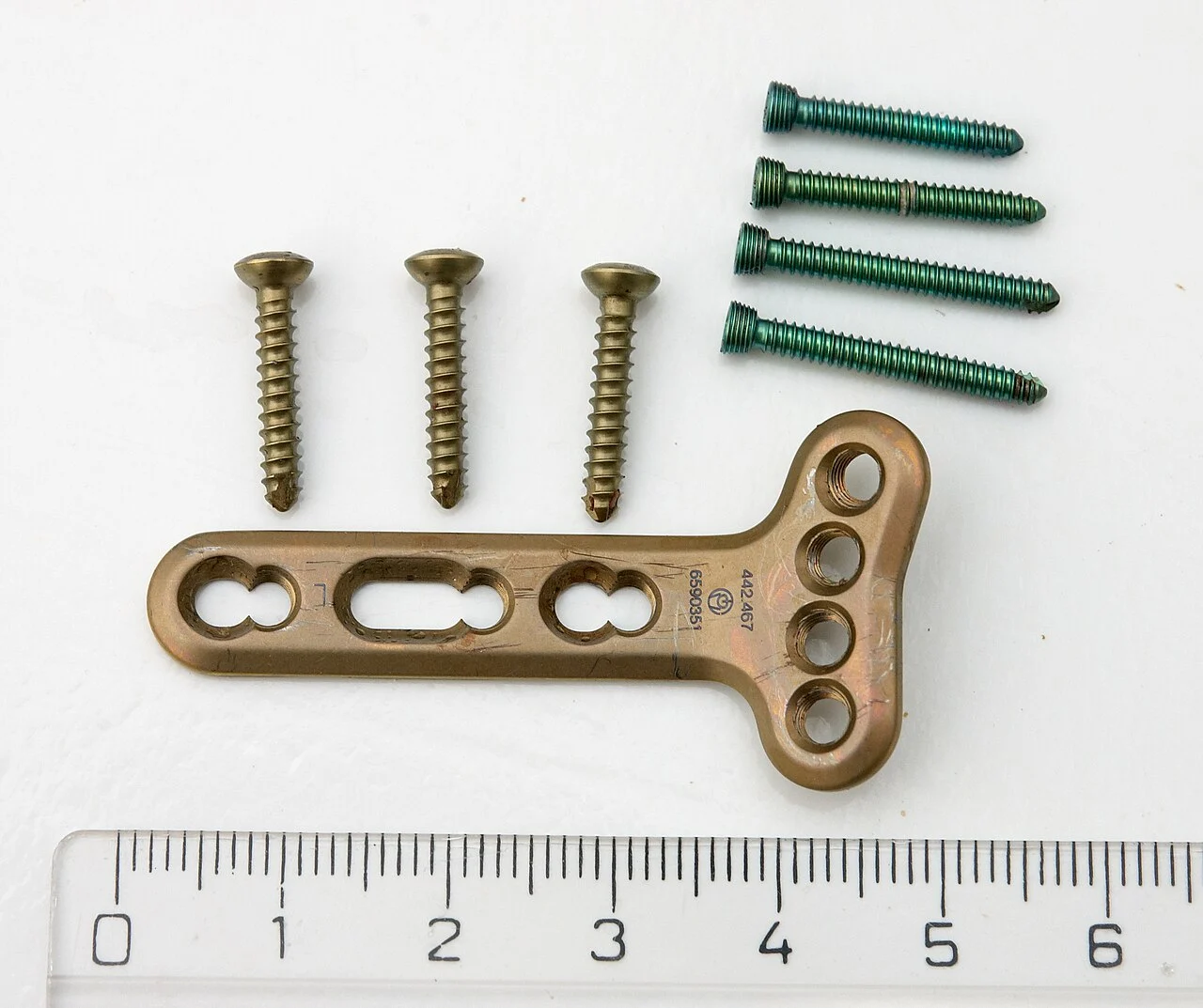
Titanium plate and cortical bone screws (Grade 23 ELI, Ti-6Al-4V) used for orthopedic fracture fixation. Medical-grade titanium fasteners require ISO 10993 biocompatibility documentation and FDA compliance. Photo: Wikimedia Commons / CC BY-SA.
The medical device industry uses titanium fasteners — primarily Grade 23 (Ti-6Al-4V ELI) and Grade 4 — in orthopedic bone screws, spinal implant connectors, dental implant fixtures, and prosthetic joint attachment hardware. The biocompatibility and osseointegration capability of titanium are unique in the fastener world: no other structural metal bonds with living bone tissue so reliably.
Medical-grade titanium fasteners require full material traceability, ISO 10993 biocompatibility documentation, and in most cases FDA regulatory compliance. This is a specialized supply chain, distinct from industrial fastener sourcing.
Automotive and Motorsport
Formula 1, MotoGP, and high-performance automotive builds use Grade 5 titanium bolts extensively for engine fasteners, suspension linkages, exhaust manifold studs, and wheel hardware. The weight saving per fastener is small — a titanium M8 bolt might weigh 4 g vs. 11 g for steel — but multiplied across hundreds of fasteners in a race car, it accumulates to kilograms of weight reduction.
In production vehicles, titanium is appearing in exhaust system hardware (where both heat and weight matter) and in performance brake caliper bolts. Cost remains the barrier to wider adoption in mainstream automotive.
Chemical Processing
Chemical plant equipment — reactors, heat exchangers, pumps, agitators — in contact with chlorides, acids, or caustic media requires fasteners that won’t corrode over a 20-year plant life. Grade 2 titanium is widely used for flange bolting and equipment covers. Grade 7 is specified where reducing acids are present.
The economics are different from aerospace: chemical engineers compare the cost of premium titanium fasteners against the cost of a plant shutdown for corroded fastener replacement. The math often favors titanium within 3–5 years of service.
Architecture (Coastal and Aggressive Environments)
Titanium fasteners appear in building façade cladding systems for coastal structures where salt spray would corrode conventional hardware within years. Museums, aquariums, and marine research facilities are typical installations. The titanium aesthetic — a dark natural finish or polished silver — also has architectural value in exposed connections.
Titanium vs. Stainless Steel Fasteners

The titanium vs. stainless steel decision comes up in almost every conversation we have with engineering customers. Here’s the honest comparison.
| Property | Grade 5 Titanium | 316 Stainless Steel | A286 (Alloy Steel) |
|---|---|---|---|
| Tensile Strength | ~1,020 MPa | ~515 MPa | ~1,000 MPa |
| Density | 4.43 g/cm³ | 8.0 g/cm³ | 7.92 g/cm³ |
| Weight vs. steel | –43% | Baseline | ~Same as SS (~1% lighter) |
| Corrosion in seawater | Excellent | Good | Poor |
| Corrosion in chlorides | Excellent | Moderate | Poor |
| Modulus of Elasticity | ~114 GPa | ~193 GPa | ~200 GPa |
| Galling tendency | High | High | Low |
| Max service temp. | ~315°C (sustained) | ~870°C | ~700°C |
| Cost vs. 316 SS | 5–10× | Baseline | 1.5–3× |
| Galvanic compatibility with CFRP | Excellent | Poor | Poor |
When titanium wins:
- Weight is a primary design constraint (aerospace, motorsport, medical implants)
- Long-term seawater or chloride exposure (marine, offshore, coastal architecture)
- Contact with CFRP composites (titanium is galvanically compatible; steel is not)
- Biocompatibility required (medical implants)
When stainless steel wins:
- Budget is constrained and the corrosion environment is mild
- High-temperature applications above 315°C sustained (316 SS handles up to 870°C)
- Applications requiring high stiffness (the 43% lower modulus of titanium can be a problem in precision assemblies)
- Large-volume commodity applications where cost drives decisions
The Galling Problem: What Every Engineer Must Know
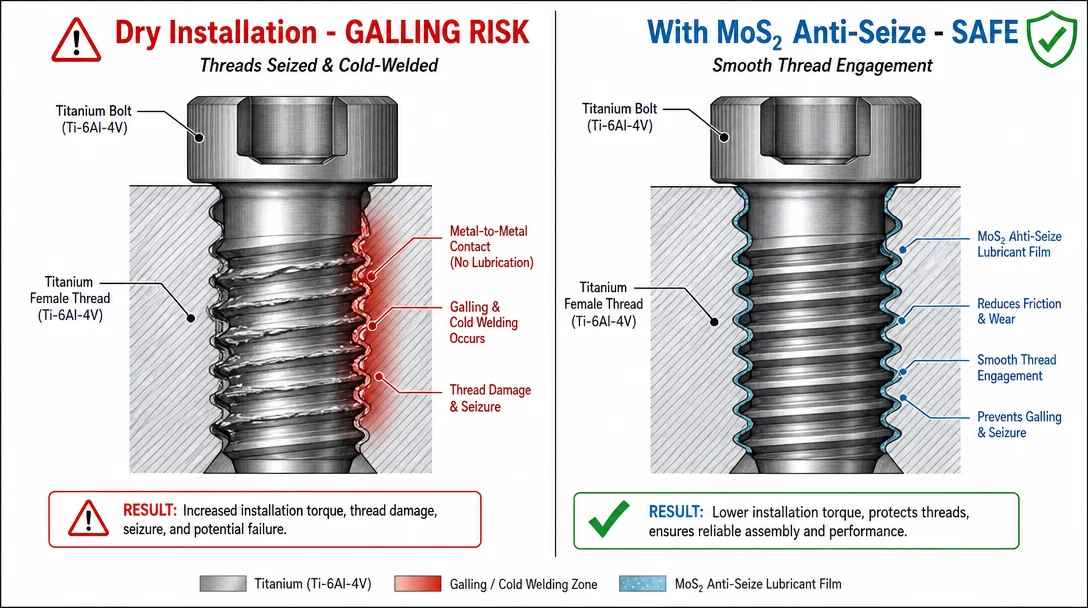
Left: dry titanium threads seize and cold-weld under installation torque — the most common titanium fastener field failure. Right: MoS₂ anti-seize lubricant prevents oxide layer abrasion and allows full torque to be achieved safely.
Galling is the most common and most damaging mistake people make with titanium fasteners. It’s also the problem that almost no SERP article covers in enough detail.
What is galling? When titanium threads contact other titanium (or sometimes stainless steel) surfaces under the friction and pressure of torquing, the oxide layers that protect the metal get abraded away. The bare metal surfaces then cold-weld — microscopically bonding together under pressure. The result: threads seize mid-installation, and attempting to continue torquing shears off the fastener or destroys the threads. A Grade 5 bolt at $12 becomes scrap, and so does the threaded hole.
Titanium’s vulnerability to galling stems from two properties: high coefficient of friction and strong affinity for adhesion between like metals. Titanium-on-titanium is the worst case. Titanium-on-stainless is also problematic. Titanium threaded into aluminum or anodized aluminum is less prone to galling.
Three ways to prevent galling:
- Thread lubricant (most critical). Apply an anti-seize compound to the threads before installation — every time, without exception. Molybdenum disulfide (MoS₂) paste is the aerospace-standard choice. Silver-based anti-seize and nickel-based compounds also work. Teflon (PTFE) tape is acceptable for low-load applications. Never install titanium fasteners dry into titanium tapped holes.
- Controlled installation speed. Run the fastener down slowly, by hand if possible for the first several turns. Power tools applied at high speed generate frictional heat that destroys the oxide layer before you can feel the galling starting. Use a torque wrench at the final stage — set to titanium-specific torque values, not steel tables.
- Surface treatments. For high-volume or critical applications, anti-galling coatings (such as CANADIZE by Magnaplate or anodizing with PTFE impregnation) can be applied to titanium threads. These add cost but are justified where repeated removal and reinstallation is required (maintenance access panels, inspection covers).
What to do if a titanium bolt starts to gall: Stop immediately. Do not apply more torque. Back the fastener out carefully with slow, steady counter-torque. Inspect the threads — if they’re damaged, the fastener and the tapped hole may both be unserviceable. Replacing the galled fastener and re-tapping or inserting a Helicoil into the damaged hole is the typical repair path.
This is based on actual installation and warranty cases we’ve handled. The pattern is always the same: installer skips the anti-seize, installs too fast, fastener seizes at 60% of target torque.
How to Specify Titanium Fasteners
Specifying titanium fasteners correctly prevents wrong-grade shipments, certification issues, and costly rejects. The key standards:
ASTM F468 / F468M — covers titanium and titanium alloy bolts, screws, and studs. Specifies grades 1, 2, 3, 4, 5, 6, 7, 8, and 23. Defines tensile strength requirements, dimensional tolerances, and test methods.
ASTM F467 / F467M — covers titanium and titanium alloy nuts. Same grade coverage as F468.
ASTM B348 — titanium and titanium alloy bar and billet. Governs the raw material from which machined fasteners and studs are produced.
AMS 4928 — the Aerospace Material Specification for Ti-6Al-4V bar, billet, and extrusion. Required for fasteners used in certified aerospace structures. More stringent than ASTM F468 on chemistry and testing requirements.
ASTM F136 — specifically for Ti-6Al-4V ELI (Grade 23) surgical implant applications.
On certifications: When ordering titanium fasteners for aerospace or medical applications, always require a Material Test Report (MTR) or Certificate of Conformance (CoC) with each shipment. The MTR should document: heat number, chemical composition, mechanical test results (tensile, yield, elongation), and standard compliance. For AMS 4928 parts, also require a Certificate of Conformance to the aerospace standard.
Thread form: Specify metric per DIN 13 or inch per ASME B1.1 (UNC/UNF). Titanium is available in fine thread pitch variants, which are often preferred in aerospace for thread engagement in thin-wall structures.
Surface finish: As-machined, passivated, anodized (Type II or Type III), or coated. Anodizing Type II adds visual identification and marginal corrosion enhancement. Some aerospace applications specify a dry film lubricant factory-applied to threads to address galling risk on delivery.
Summary
Titanium fasteners earn their cost premium in applications where weight, corrosion resistance, and long service life are genuine engineering requirements — not marketing preferences. Grade 5 (Ti-6Al-4V) covers the majority of structural applications with its combination of ~1,020 MPa tensile strength and 43% weight advantage over steel. Grade 2 is the right choice for maximum corrosion resistance in chemical and marine environments. Grade 23 ELI is non-negotiable for medical implant hardware.
The single biggest field failure we see with titanium fasteners isn’t the wrong grade — it’s galling from dry installation. No matter how good the fastener, skipping anti-seize in a titanium-to-titanium joint will cost you the hardware and the installation.
Specify to ASTM F467/F468 or AMS 4928, demand MTRs with every shipment, and treat titanium fasteners as the precision components they are. They’ll reward you with decades of trouble-free service.
FAQ
What are titanium fasteners used for?
Titanium fasteners are used in aerospace structures, marine equipment, medical implants, motorsport vehicles, chemical processing equipment, and coastal architecture — anywhere the combination of low weight, high strength, and corrosion resistance justifies the cost premium over stainless steel.
What grade of titanium is best for fasteners?
Grade 5 (Ti-6Al-4V) is the most commonly specified grade for structural fasteners, offering ~1,020 MPa tensile strength at 4.43 g/cm³ density. Grade 2 is preferred for maximum corrosion resistance in chemical and marine environments. Grade 23 (Ti-6Al-4V ELI) is required for medical implant applications.
Are titanium fasteners stronger than steel?
Grade 5 titanium fasteners have approximately twice the tensile strength of 316 stainless steel (1,020 MPa vs. 515 MPa) at nearly half the weight. Compared to high-strength alloy steel fasteners (Grade 8 / 10.9), titanium’s strength is roughly comparable, but titanium remains ~43% lighter.
Why do titanium bolts gall?
Titanium has a high coefficient of friction and a strong affinity for adhesion between like-metal surfaces. When titanium threads contact other titanium threads under installation pressure, the protective TiO₂ oxide layers abrade away and the bare metal surfaces cold-weld together. Applying MoS₂ anti-seize lubricant and installing at low speed prevents galling.
What anti-seize should I use on titanium fasteners?
Molybdenum disulfide (MoS₂) paste is the aerospace-standard choice for titanium fastener anti-seize. Silver-based anti-seize compounds also work well. PTFE (Teflon) tape is acceptable for low-load applications. Never install titanium-to-titanium threads dry.
How much do titanium fasteners cost compared to stainless steel?
Titanium fasteners typically cost 5–10× more than equivalent 316 stainless steel hardware, depending on grade, head form, and order volume. Grade 7 (with palladium) and Grade 23 (ELI) command higher premiums. The cost is typically justified for aerospace, marine, and medical applications where weight savings, longevity, or biocompatibility are primary requirements.
Are titanium fasteners galvanically compatible with carbon fiber?
Yes. Titanium is galvanically compatible with carbon fiber reinforced polymer (CFRP) composites — an important reason for its widespread use in CFRP-dominant aerospace structures like the Boeing 787. Steel fasteners in direct contact with CFRP create a galvanic cell that accelerates steel corrosion. Titanium does not.