 Chat on WhatsApp


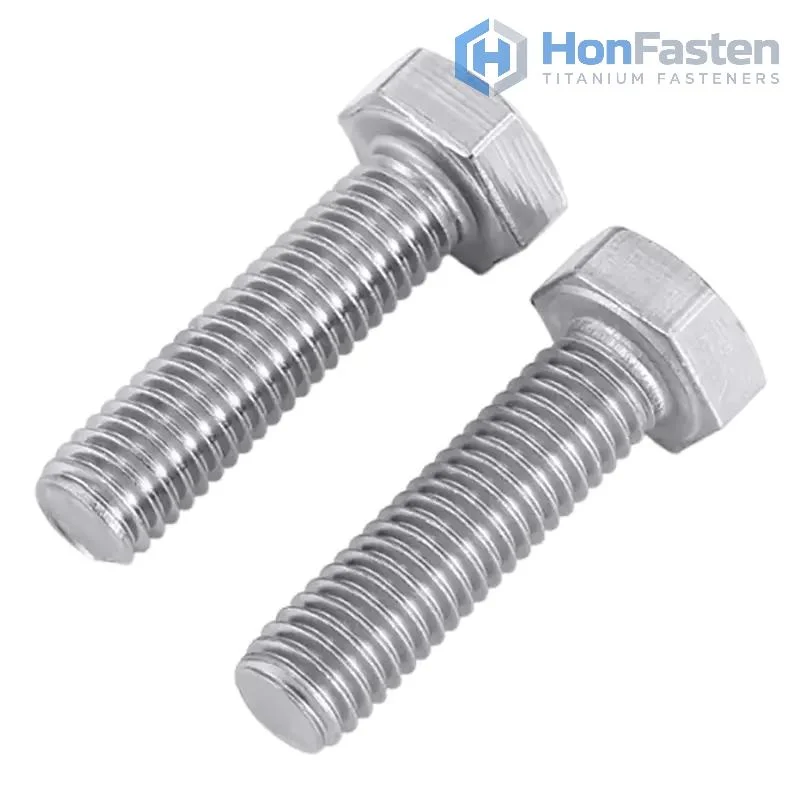
| Parameter | Value |
|---|---|
| Material Grade | Grade 2 (UNS R50400) / Grade 5 Ti-6Al-4V (UNS R56400) |
| Standard | DIN 933-1987 (dimensions) · ASTM B348 (material) |
| Thread Form | ISO metric coarse per DIN 13-1 |
| Thread Tolerance | 6g (Product Grade A and B) |
| Size Range | M3 × 6 — M52 × 300 |
| Product Grade | A (M3–M24, l ≤ 10d or ≤ 150 mm) / B (M24–M52 or l > Grade A limits) |
| Available Lengths | 6 mm — 300 mm (custom lengths available) |
| Mill Test Certificate | EN 10204 3.1 |
| MOQ | 100 pcs per size/grade |
| Lead Time | 15–25 business days |
Titanium hexagon head bolts to DIN 933-1987 are produced from titanium and titanium alloy bar stock conforming to ASTM B348, covering both unalloyed (Grade 2) and α+β alloy (Grade 5) compositions. Grade selection determines the mechanical performance envelope: Grade 2 offers maximum corrosion resistance and ductility at moderate strength; Grade 5 (Ti-6Al-4V) doubles the tensile strength while retaining corrosion immunity and reducing density compared with structural steels.
Both grades form a stable, self-repairing titanium dioxide (TiO₂) surface oxide in air or moist environments. This passive layer resists seawater, chlorides, hypochlorite solutions, nitric acid, and many organic acids without additional coating or plating, making DIN 933 titanium bolts suitable for permanently submerged or chemically aggressive service conditions where stainless steel fasteners are prone to crevice or pitting corrosion.
| Element | Min (%) | Max (%) |
|---|---|---|
| Nitrogen (N) | — | 0.03 |
| Carbon © | — | 0.08 |
| Hydrogen (H) | — | 0.015 |
| Iron (Fe) | — | 0.30 |
| Oxygen (O) | — | 0.25 |
| Titanium (Ti) | Balance | — |
| Element | Min (%) | Max (%) |
|---|---|---|
| Aluminum (Al) | 5.50 | 6.75 |
| Vanadium (V) | 3.50 | 4.50 |
| Iron (Fe) | — | 0.40 |
| Oxygen (O) | — | 0.20 |
| Nitrogen (N) | — | 0.05 |
| Carbon © | — | 0.08 |
| Hydrogen (H) | — | 0.015 |
| Other (each) | — | 0.10 |
| Other (total) | — | 0.40 |
| Titanium (Ti) | Balance | — |
| Property | Grade 2 (UNS R50400) | Grade 5 / Ti-6Al-4V (UNS R56400) | Test Method |
|---|---|---|---|
| Tensile Strength (UTS) | 345 MPa min (50 ksi) | 897 MPa min (130 ksi) | ASTM E8 |
| Yield Strength (0.2% offset) | 275 MPa min (40 ksi) | 827 MPa min (120 ksi) | ASTM E8 |
| Elongation in 50 mm (min) | 20% | 10% | ASTM E8 |
| Reduction of Area (min) | 30% | 25% | ASTM E8 |
| Density | 4.51 g/cm³ | 4.43 g/cm³ | — |
DIN 933-1987 defines the hexagonal head, fully threaded bolt geometry for ISO metric coarse thread series from M2 to M52. All dimensions conform to DIN 13-1 (ISO metric thread) with thread tolerance class 6g. The bearing face under the head meets the flatness and surface requirements of ISO 4759-1.
| Nominal Size | Thread Pitch (mm) | s — Width Across Flats (mm) | k — Head Height (mm) |
|---|---|---|---|
| M3 | 0.50 | 5.5 | 2.0 |
| M4 | 0.70 | 7.0 | 2.8 |
| M5 | 0.80 | 8.0 | 3.5 |
| M6 | 1.00 | 10.0 | 4.0 |
| M8 | 1.25 | 13.0 | 5.3 |
| M10 | 1.50 | 17.0 | 6.4 |
| M12 | 1.75 | 19.0 | 7.5 |
| M14 | 2.00 | 22.0 | 8.8 |
| M16 | 2.00 | 24.0 | 10.0 |
| M20 | 2.50 | 30.0 | 12.5 |
| M24 | 3.00 | 36.0 | 15.0 |
| M27 | 3.00 | 41.0 | 17.0 |
| M30 | 3.50 | 46.0 | 18.7 |
| M33 | 3.50 | 50.0 | 21.0 |
| M36 | 4.00 | 55.0 | 22.5 |
| M42 | 4.50 | 65.0 | 26.0 |
| M48 | 5.00 | 75.0 | 30.0 |
| M52 | 5.00 | 80.0 | 33.0 |
All s and k values are nominal. Tolerances are per ISO 4759-1 (Product Grade A for M3–M24; Product Grade B for M24–M52).
Product Grade A and Product Grade B describe dimensional tolerance classes defined in ISO 4759-1 and applied by DIN 933-1987:
The two grades are dimensionally interchangeable in many assemblies. When a drawing specifies “DIN 933” without an explicit grade, Product Grade A is assumed for sizes M3–M24.
Titanium hexagon head bolts to DIN 933-1987 serve as structural fasteners in environments where corrosion resistance, low weight, or biocompatibility rules out carbon steel or standard austenitic stainless steel.
DIN 933-1987 is a German industrial standard published by DIN (Deutsches Institut für Normung) that specifies hexagonal head bolts with full metric coarse thread. “Full thread” means the thread extends the entire usable length of the shank with no unthreaded grip section, distinguishing this bolt from DIN 931 (partially threaded). The 1987 edition remains the most widely referenced revision and is dimensionally equivalent to ISO 4017:2011.
Yes. DIN 933 defines hexagon head screws in which the entire shank length carries the thread — the bolt is fully threaded from directly under the head to the tip. This is the fundamental difference between DIN 933 (full thread) and DIN 931 (partial thread, with an unthreaded shank section). Full thread bolts permit the nut to engage at any point along the shank, providing greater flexibility when the grip length varies.
DIN 933-1987 (German national standard) and ISO 4017 (international standard, current edition) specify the same hexagon head fully threaded bolt geometry for metric coarse thread and are dimensionally interchangeable for sizes covered by both. ISO 4017 is the current active international standard; DIN 933 is the legacy German designation still present on older engineering drawings and procurement specifications. When substituting, confirm that tolerance class (6g thread and ISO 4759-1 body tolerances) and head dimensions match.
Product Grade A applies to bolts in sizes M3 to M24 with length not exceeding 10 × d or 150 mm. It specifies tighter dimensional tolerances and a finer machined surface on the bearing face, making it the standard choice for precision assemblies. Product Grade B applies to larger or longer bolts (above M24 or lengths exceeding the Grade A criteria) and uses coarser tolerance limits as defined in ISO 4759-1. Both grades use thread tolerance class 6g. When a drawing specifies DIN 933 without an explicit grade, Product Grade A is assumed for sizes M3–M24.
Titanium DIN 933-1987 bolts are produced in two principal grades: Grade 2 (commercially pure titanium, UNS R50400, ASTM B348) with a minimum tensile strength of 345 MPa, chosen for maximum corrosion resistance and ductility in chemical and marine environments; and Grade 5 (Ti-6Al-4V alloy, UNS R56400, ASTM B348) with a minimum tensile strength of 897 MPa, chosen for high-strength structural joints in aerospace, motorsport, and subsea applications. Grade 4 (340 MPa YS, highest strength among unalloyed grades) is available on request for applications requiring a pure-titanium chemistry at higher strength.
Both Grade 2 and Grade 5 titanium form a tenacious, self-repairing titanium dioxide (TiO₂) oxide layer on exposure to air or water. This passive layer resists seawater, chloride solutions, hypochlorite, nitric acid up to fuming concentrations, and many organic acids without additional surface treatment. Unlike austenitic stainless steels, titanium is immune to chloride-induced stress corrosion cracking and pitting in ambient-temperature seawater service, making it the preferred fastener material for permanently submerged and splash-zone applications.
Each delivery of titanium DIN 933-1987 bolts is accompanied by an EN 10204 3.1 Mill Test Certificate (MTC) issued by the material manufacturer and covering chemical composition and mechanical properties, traceable to the specific heat number. Additional documentation available on request includes dimensional inspection reports, hardness certificates, and ISO 9001 conformity declarations.
The minimum order quantity is 100 pcs per size and grade combination. Custom sizes, lengths, and non-standard thread pitches (fine thread series) are available with higher MOQs. Contact the sales team for specific project requirements and volume pricing.